Moving to New Zealand offers a rare combination of incredible career opportunities, a high standard of living, and an unparalleled outdoor lifestyle. However, before you can pack your bags and start your new life in Aotearoa, you must successfully navigate the country’s immigration system. Securing a New Zealand Work Visa is the most critical step in your relocation journey. Recent sweeping changes to immigration policy have streamlined the process but placed strict new requirements on both employers and applicants. This comprehensive guide breaks down the different visa types, eligibility criteria, the latest pathways to residency, and the step-by-step application process to help you successfully move abroad and advance your career.
Understanding the New Zealand Work Visa System
The New Zealand government recently overhauled its immigration system to prioritize highly skilled workers and protect migrants from exploitation. The old system, which featured several different temporary work visas, has largely been replaced by an employer-led framework. Today, the primary burden is placed heavily on the local company hiring you.
Before you can apply for the standard work visa, your prospective employer must prove they are a legitimate business that treats workers fairly and cannot find a New Zealander to fill the role. This shift means your first challenge is not applying to immigration, but rather securing a job offer from an approved local company.
The Accredited Employer Work Visa (AEWV)
For the vast majority of expats, the Accredited Employer Work Visa is the primary route into the country. Introduced as the main temporary work visa, the AEWV allows you to live and work in New Zealand for up to five years, depending on your pay rate and skill level.
The AEWV application process is broken down into three distinct phases:
- Employer Accreditation: The New Zealand employer must apply to the government to become accredited, proving they are a viable business compliant with local employment laws.
- The Job Check: Once accredited, the employer applies for a Job Check for the specific role. They must demonstrate that the job pays the market rate and prove they have advertised the role locally without success.
- The Migrant Check: Only after the Job Check is approved can the employer send you an invitation to apply for the visa. At this stage, you must prove you have the required skills, work experience, and qualifications to succeed in the role.
The Green List: Fast-Tracking Your Residency
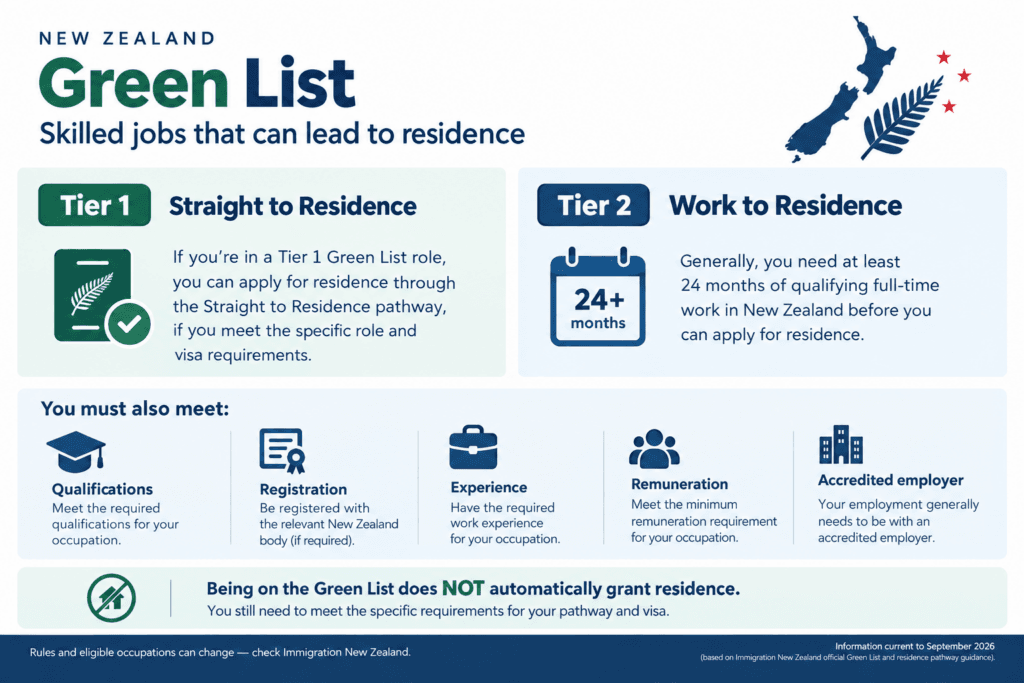
If you possess skills that are in critically short supply, you may qualify for a highly advantageous route known as the Green List. The government maintains a register of highly sought-after occupations in sectors like construction, engineering, healthcare, and technology. According to the official Green List pathway to residence provided by the government, this system offers two distinct tiers that allow for a clear transition from a New Zealand Work Visa to permanent residency.
- Tier 1 (Straight to Residence): Occupations on Tier 1 are in incredibly high demand. If you secure a job offer in a role like a clinical psychologist, civil engineer, or construction project manager, and meet the specific qualification requirements, you can apply for residency immediately upon arriving in the country.
- Tier 2 (Work to Residence): Roles on Tier 2—such as registered nurses, teachers, and specialized tradespeople—require you to work in New Zealand on an AEWV for 24 months. Once you have completed this period with an accredited employer, you become eligible to apply for your permanent residence visa.
Essential Requirements for Approval
Regardless of which specific visa pathway you follow, the immigration authorities require all applicants to meet strict baseline criteria to ensure they are of good character and in good health.
- Health Requirements: You will likely need to undergo a medical examination and a chest X-ray to prove you do not pose a public health risk or a significant burden on the country’s healthcare system. These checks must be completed by an approved panel physician.
- Character and Police Checks: You must provide a police certificate from your country of citizenship and any country where you have lived for more than five years since turning 17. The government stringently screens for serious criminal convictions.
- English Language Proficiency: Depending on the skill level of your job, you may need to prove your ability to speak and understand English. This can be demonstrated through recognized testing systems like IELTS, or through your citizenship and educational background.
Steps to Secure Your Visa
Moving abroad is complex, but breaking the visa application process into manageable steps ensures you stay organized and avoid costly delays.
- Secure an Eligible Job Offer: Focus your job search on companies that are already accredited. If you receive an offer from a non-accredited employer, they will need to go through the lengthy accreditation process before you can proceed.
- Verify Your Credentials: Ensure your qualifications are recognized in New Zealand. Some professions require occupational registration with a governing body before a visa can be legally granted.
- Prepare Your Documentation: Gather your passport, employment agreement, translated educational certificates, and proof of past work experience. Order your police checks early, as these can take weeks to process.
- Submit Your Application: Once your employer sends you the official token linked to their approved Job Check, you will create an online account, complete the application form, upload your supporting evidence, and pay the associated processing fee.
Conclusion
Securing a New Zealand Work Visa requires careful planning, patience, and a solid understanding of the country’s employer-led immigration framework. By focusing your efforts on finding an accredited employer and ensuring your skills align with current labor shortages, you can significantly improve your chances of approval. Whether you are aiming for a temporary adventure or a permanent move through the Green List, preparing your documentation early is the key to a seamless transition. With the right preparation, you will be ready to start your new chapter in one of the world’s most beautiful countries.